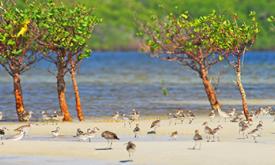

Biodiversity & Forest

Title: Africa Regional Centres of Excellence - ArcX: Biodiversity & Forest Component. 

Main Objective: The Biodiversity & Forest Component of the ArcX programme focuses on the sustainable management of biodiversity, forests, protected areas, and ecosystems across Africa. Its goal is to maintain ecosystem services essential for the well-being of local populations.

Specific Objectives:

  1. Establish Regional Centres of Excellence (RCoEs) as reference points for biodiversity data to inform policies;
  2. Develop indicators and information systems to monitor the EU-supported NaturAfrica initiative;
  3. Enhance cross-sectoral and cross-regional coordination among stakeholders to address challenges in Science, Technology, and Innovations (STI) for Africa’s green transition;
  4. Focus on metrics for decision-making, effective management of protected areas, development of forest information systems, and supporting national conservation efforts and global reporting (e.g., NBSAPs).

Starting Year: 2024
Implementation Duration: 48-54 months

Areas of Impact:

  1. Data Collection and Sharing: Harmonising and making biodiversity, forestry, and ecosystem data accessible through open-source systems;
  2. Scientific and Policy Support: Delivering scientific and policy analyses to improve regional decision-making;
  3. Capacity Building: Strengthening institutional and human capacities for better coordination among biodiversity stakeholders;
  4. Global Engagement: Collaborating with continental and global institutions like the CBD to sustain biodiversity conservation and ecosystem services.

Target Groups: Continental bodies, research institutions, academia, civil society, private sector, local communities, and all African citizens.

ArcX Partners: See ArcX Partners card and the ArcX Partnership Map.

Intermediary Organisations: Center for International Forestry Research and World Agroforestry (CIFOR-ICRAF).

Scientific and Technical Support from EC - DG JRC: JRC Unit D6 (Nature Conservation and Observations).


Go to:

To make a selection from a map visit the Datasets Page

Available Resources
Displaying 46 - 60 of 86
Whether you’re monitoring crops, modelling green energy installations or soil sealing, combatting loss of natural resources or just helping countries meet their Sustainable Development Goals, chances ...
Land cover is defined as the physical material at the surface of the earth, usually documented via the interpretation of earth observations. Common land cover types include trees, grass, bare ground, ...
The CO2 fixed by photosynthesis is one of the most important components of the carbon cycle. Forests play a key role in this process. They represent large and persistent carbon sinks. Tree carbon stoc...
Africa’s extraordinary richness in biodiversity and ecosystem services comprises a strategic asset for sustainable development. Yet the decline and loss of biodiversity hampers the sustainable social ...
Park managers in many countries across Africa need to monitor and understand their parks features and overall health. They can rely on the highly detailed land cover information offered by the Coperni...
Key Biodiversity Areas (KBAs) are the most important places in the world for species and their habitats. Faced with a global environmental crisis we need to focus our collective efforts on conserving ...
The availability and quantity of observational species occurrence records have greatly increased due to technological advancements and the rise of online portals, such as the Global Biodiversity Infor...
Vegetation fires have become a major concern in Africa because of their negative impacts on the environment and on human welfare. Uncontrolled (and un-prescribed) wildfires cause forest and vegetation...
The data provided here are the result of a time-series analysis of carbon density change (in Mg/ha) between 2003-2014 spanning tropical America, Africa, and Asia (23.45 N lat.-23.45 S lat.). The origi...
This dataset is an index that estimates the relative value provided by coral reefs that protect coastlines through reduction of wave height and wave energy. The value as of 2014 is modelled as a funct...
The Biodiversity Intactness Index shows the modelled average abundance of originally-present species in a grid cell, as a percentage, relative to their abundance in an intact ecosystem. Originally ava...
Africa’s extraordinary richness in biodiversity and ecosystem services comprises a strategic asset for sustainable development. Yet the decline and loss of biodiversity hampers the sustainable social ...
Forest canopy height measures the average height of the tree canopy in 2012. This dataset is created by integrating broadscale optical remotely sensed data at 30-metre spatial resolution with on-the-g...
The Fraction of Photosynthetically Active Radiation Absorbed (FAPAR) is used to track the overall primary productivity associated with atmospheric CO2 fixation. FAPAR anomalies relative to the average...
The Global 200 is the list of ecoregions identified by WWF, the global conservation organization, as priorities for conservation. According to WWF, an ecoregion is defined as a "relatively large unit ...