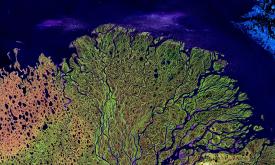
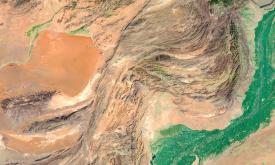
Water is essential for life on Earth and a critical natural resource that underpins all social and economic activity. Ensuring water and sanitation for all is one of the Sustainable Development Goals ...
Mangroves are trees or shrubs adapted to saline and brackish environments. They are found in the intertidal zone of tropical and sub-tropical coastlines. Mangrove forests are among the most productive...
At any given place on Earth, complex human-environment interactions are at play. They include differing rates and magnitudes of drivers (e.g. overgrazing, climate change, agricultural practices) and d...
Biomes are distinct biological communities (collection of plants and animals) that have formed in response to a shared physical climate. The 11 major terrestrial biomes found in Africa (out of 14 worl...
Tropical moist forests have a huge environmental value. They play an important role in biodiversity conservation, terrestrial carbon cycle, hydrological regimes, indigenous population subsistence and ...
Mapping ongoing project activities in the field of conservation in protected areas is essential to identify the various actors and to identify the areas where information and actors are scarce. The ai...
Tensions over freshwater use and management in international river basins are one of the main concerns in political relations. They may exacerbate existing tensions, increase regional instability and ...
Biomes are distinct biological communities (collection of plants and animals) that have formed in response to a shared physical climate. They are distinguished by characteristic temperatures and amoun...
Africa is very rich in biodiversity and is the last place on Earth with a significant assemblage of large mammals. This natural richness, accumulated over millions of years, coupled with the wealth of...
Higher energy demands in Africa has led to a wide expansion of the number of hydropower sites, mainly between the 1960s and 1980s. The construction of dams causes impoundments of rivers and reservoirs...
Tropical moist forests have a huge environmental value. They play an important role in biodiversity conservation, terrestrial carbon cycle, hydrological regimes, indigenous population subsistence and ...
Many African countries, especially in the Sub-Saharan region highly depend on hydropower which is one of the energy sources that are most affected by droughts. At the same time hydropower has a huge i...
Tropical moist forests have a huge environmental value. They play an important role in biodiversity conservation, terrestrial carbon cycle, hydrological regimes, indigenous population subsistence and ...
Oil seed crops, especially oil palm, are among the most rapidly expanding agricultural land uses, and their expansion is known to cause significant environmental damage. Accordingly, these crops often...
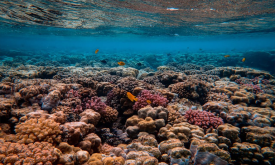
Healthy coral reefs provide a home for millions of aquatic species. They protect coastal homes from storms and support commercial and subsistence fisheries as well as jobs and businesses through touri...